
Ninja HydraSense vs Brita Hub: Cost and Certifications
Compare certified contaminant claims, 12-month filter costs, controls, and counter fit to choose between Ninja HydraSense and Brita Hub for your tap water.
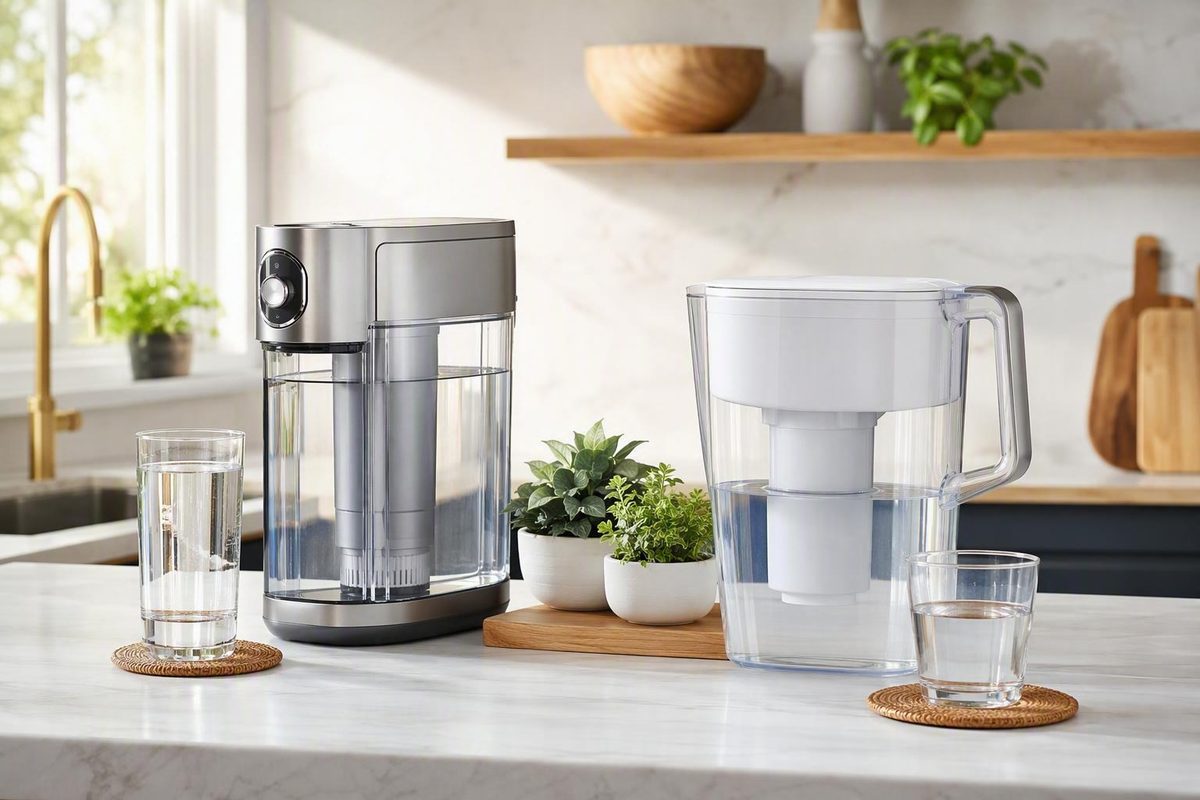
Ninja HydraSense is the stronger choice for documented certification scope, custom pours, filter tracking, and narrow counters; Brita Hub is better for a shallower footprint, simpler controls, and a reservoir that can sit behind or beside the dispenser. Do not choose by the 80-plus versus 70-plus contaminant totals. Check the exact contaminant on your water report, then compare annual filter cost—an overall cost winner cannot be named because current Brita Hub replacement-filter pricing was not available in the supplied evidence.
Enter your water use and current filter prices, then search the claim table for the contaminant on your water report.
Compare Your First-Year Cost
Editable example: Ninja $199.99 + $39.99 per replacement; Brita $194.95 + your replacement price. These are reference prices, not live quotes.
Edit Machine And Ninja Filter Prices
How The Cost Is Calculated
Method: annual gallons = daily gallons × 365. Filters are rated for 120 gallons or about six months, whichever comes first. First-year cost includes the machine and purchased replacements; taxes, shipping, electricity, discounts, priming water, and early changes caused by water conditions are excluded.
Compare The 12 Documented Claims
| Advertised total | More than 80 contaminants | More than 70 contaminants | Not comparable as a score |
| Lead | — in supplied comparison evidence | Claims 99% lead reduction | Brita claim; verify model listing |
| Seven-PFAS mixture | Included in stated NSF/ANSI 53 certification scope | — in supplied evidence | Ninja certified claim |
| PFAS, general | Advertised category; consult exact performance sheet | — in supplied evidence | Ninja claim details vary by substance |
| Microplastics | Advertised category | Advertised reduction | Claimed by both; inspect exact listings |
| Certain pharmaceuticals | Advertised category under stated NSF/ANSI 401 scope | — in supplied evidence | Ninja has more explicit documentation |
| Chlorine | NSF/ANSI 42 certification stated for specified claims | Advertised reduction | Exact claim sheets still control |
| NSF/ANSI 42 | IAPMO R&T certification stated | Standard number not supplied | Confirmed for specified Ninja claims |
| NSF/ANSI 53 | IAPMO R&T certification stated | Standard number not supplied | Confirmed for specified Ninja claims |
| NSF/ANSI 401 | IAPMO R&T certification stated | Standard number not supplied | Confirmed for specified Ninja claims |
| “Up to 99%” | Applies only to certain named claims | 99% is specifically attached to lead | Not a whole-filter percentage |
| Unsafe or untreated water | Expressly excluded by manufacturer guidance | No microbiological certification established here | Neither is verified here for this use |
Showing all 12 evidence rows. Search for the contaminant named on your water report.
Source: manufacturer product pages and support documentation cited in the article. A missing claim means unknown here, not proof that a filter cannot remove it. Check the current model-specific performance sheet.
The Main Differences at a Glance
Both products are powered, refillable countertop dispensers with no permanent plumbing. Each has a roughly 96-ounce reservoir and a filter rated for 120 gallons or about six months. Their documented system prices are also close: $199.99 for Ninja HydraSense and $194.95 for Brita Hub. HydraSense also had a $160 introductory launch price, but temporary promotions should not drive a long-term comparison.
| Specification | Ninja HydraSense | Brita Hub |
|---|---|---|
| Reservoir | 96 oz / 3 L | 12 cups / ~96 oz |
| Dimensions | 14.37 × 5.07 × 13.78 in | 11.4 × 7.5 × 14.4 in |
| Weight | 6.6 lb | 7.9 lb |
| Filter rating | 120 gal / ~6 months | 120 gal / up to 6 months |
| Presets | Saved custom volumes | 12 oz and 20 oz |
| Manual dispensing | Documented controls vary by SKU | Yes |
| Filter display | Percentage and stages | Red after 120 gallons |
| Water temperature | Room temperature | Room temperature |
Ninja is approximately 2.4 inches narrower, while Brita is approximately 3 inches shallower and 0.6 inch taller. Neither actively refrigerates water.
Ninja Has the Clearer Certification Record
SharkNinja says HydraSense reduces more than 80 contaminants, with up to 99% reduction for certain claims. Advertised categories include PFAS, microplastics, and certain pharmaceuticals. “Up to 99%” is not a blanket reduction rate: it applies only to the particular claims and test conditions identified in the performance documentation.
HydraSense is certified by IAPMO R&T to NSF/ANSI 42, 53, and 401 for specified claims in its performance data sheet. Its NSF/ANSI 53 scope includes the seven-PFAS mixture identified in the supplied product evidence.
These standards cover different types of claims:
- NSF/ANSI 42 addresses specified aesthetic effects, such as chlorine taste, odor, and particulate claims.
- NSF/ANSI 53 covers specified health-related contaminant reductions.
- NSF/ANSI 401 covers specified emerging-compound claims, potentially including certain pharmaceuticals and microplastics.
Certification remains claim-specific. Certification to NSF/ANSI 53 does not mean a filter reduces every health-related contaminant covered by that standard. The applicable listing and performance data sheet must name the substance.
Brita says Hub reduces more than 70 contaminants, including lead, chlorine, and microplastics. It specifically claims 99% lead reduction. That percentage concerns lead, not every contaminant in the advertised total.
The supplied Brita Hub product page says the system is certified but does not identify its applicable NSF/ANSI standard numbers. Assigning it a particular standard without a current, model-specific performance sheet or certification record would be unsupported.
That makes Ninja’s documentation more useful for someone investigating PFAS or certification scope. It does not prove HydraSense outperforms Hub for every contaminant. Brita’s explicit 99% lead claim may be directly relevant to a household with lead on its report, but it still needs to be checked against the current model documentation, rated capacity, and certification listing.
The NSF certified drinking-water product database can be searched by manufacturer, model, standard, and reduction claim. Its search page is not itself confirmation for either machine. Match any result to the exact model number and current performance sheet.
Contaminant Totals Do Not Establish a Winner
The 80-plus and 70-plus figures are not comparable filtration scores. Manufacturers can test different substances, group related compounds differently, report different reduction percentages, and certify claims under different conditions.
A longer list is irrelevant if it omits the contaminant in your water. For lead, compare the named lead reduction, certification, rated capacity, and testing conditions. For PFAS, look for the specific compound or mixture rather than relying on a general PFAS label.
Neither system should be assumed to make untreated or microbiologically unsafe water potable. SharkNinja specifies clean, cold, non-carbonated, municipally treated tap water and excludes pond water, untreated water, and microbiologically unsafe water. The supplied evidence does not establish that Brita Hub is certified for a particular microbiological hazard.
Annual Cost Depends on Filter Consumption
Both included filters carry a 120-gallon rating and an approximate six-month limit. The earlier threshold controls replacement. A household using 20 gallons per month reaches 120 gallons in six months. At 30 gallons per month, it reaches the rating in four months.
The listed Ninja replacement price is $39.99 for one filter or $69.99 for two. At rated capacity, that equals approximately $0.33 per gallon for a single filter or $0.29 per gallon when buying the two-pack. These figures cover filter purchases only; they exclude the machine, taxes, shipping, electricity, subscription discounts, and water discarded during priming.
A first-year calculation must account for the included filter. At one filtered gallon per day, annual demand is 365 gallons. That requires four filters when each is replaced by 120 gallons, so the owner buys three replacements after using the included filter. At the $39.99 single-filter price, Ninja’s first-year system-and-filter cost is $319.96.
Low consumption does not make one filter last indefinitely. The approximate six-month calendar limit means a household using less than 240 gallons annually should still plan around two filters during a full year unless the current manufacturer instructions say otherwise.
Current Brita Hub replacement-filter pricing was absent from the supplied evidence, so its first-year and per-gallon costs cannot be completed without a live price. Enter that price in the calculator rather than treating the missing figure as zero.
Source water can shorten useful life. Brita notes that sediment, sand, or rust may slow flow and require earlier replacement. A meaningful decline in flow or applicable manufacturer guidance can therefore override the nominal calendar estimate.
Ninja Offers More Customization and Monitoring
Ninja documents one-touch dispensing, preset quantities, and up to three saved custom volumes. Its display provides water-usage information and percentage-based filter status. Those features suit households repeatedly filling several differently sized bottles, coffee brewers, or cooking vessels.
Its documented filter stages are “Excellent” from 100% to 10%, “Replace Soon” from 9% to 1%, and “Expired” at 1% or less. The written ranges overlap at exactly 1%, so the machine’s actual replacement prompt should take precedence over an attempt to interpret that boundary.
Preset quantities can vary slightly. For precision-sensitive preparation, including infant formula, SharkNinja recommends independently verifying the amount rather than assuming a preset is exact, according to the HydraSense support documentation.
Brita’s documented interface is simpler: 12-ounce and 20-ounce presets plus manual fill. Those presets match common glasses and reusable bottles, while manual mode covers other containers. A user who rarely needs unusual volumes may not gain much from Ninja’s saved settings.
The available documentation does not support a conclusion about which interface is easier to operate, whether either machine dispenses presets more accurately, or how their pumps compare for noise and long-term reliability.
Counter Shape May Settle the Decision
Ninja’s 5.07-inch width is useful in a narrow gap, but its 14.37-inch depth makes it project farther across the counter. Brita needs 7.5 inches of width but is only 11.4 inches deep.
Brita also allows the reservoir base to sit behind or beside the dispenser. Side placement can make refilling easier under cabinets or where reaching behind the machine is awkward. Ninja uses a rear reservoir.
Both capacities are effectively equal. Brita’s 12 cups convert to approximately 96 fluid ounces, matching Ninja’s stated 96 ounces. At the same consumption, nominal refill frequency should be similar.
Published dimensions do not include every movement required to remove, fill, and replace a reservoir. Measure cabinet clearance, outlet access, cord space, and the path to the sink. The supplied documentation does not provide exact working-clearance requirements.
Capacity and dimensions also do not establish which reservoir is easier to carry or clean. Handle design, balance, sink shape, and cabinet interference require hands-on comparison.
Neither Machine Provides Refrigerated Water
Both systems normally dispense room-temperature water. They are powered filters, not countertop water coolers.
Ninja offers two ways to obtain colder water: refrigerate the removable reservoir, or add ice and use its recirculation function. Recirculation mixes water with user-supplied ice; it is not active refrigeration. Brita Hub has no documented refrigeration function in the supplied evidence.
A new Ninja filter requires a substantial initial rinse: 406 ounces, or 12,000 milliliters, or until the water runs clear. That rinse water must be discarded. This priming amount is separate from the filter’s usable rated capacity and should be considered when planning setup.
Both machines require electricity and manual reservoir filling. Neither needs a permanent water connection.
Ninja’s Speed Claim Does Not Compare It With Hub
No available evidence establishes that HydraSense dispenses faster than Brita Hub. Ninja’s advertised “six times faster” claim uses a Brita Standard gravity filter as the benchmark, not the powered Hub.
A gravity pitcher and powered countertop dispenser operate differently, so that comparison cannot rank these two machines. A first-look report from The Verge described HydraSense as dispensing quickly and noted a slight button lag, but it did not publish a measured Hub comparison or controlled flow rate.
A valid comparison would need equal volumes, identical source water, full reservoirs, filters with equivalent use, repeated trials, and separate measurements for button lag and actual dispensing time. Flow should also be compared with new and partially used filters because accumulated sediment can change performance.
Which Countertop Filter Fits Each Buyer
Choose Ninja HydraSense when the named PFAS certification, explicit NSF/ANSI 42, 53, and 401 documentation, saved custom volumes, usage display, or 5.07-inch width addresses a specific need. Its published replacement pricing also makes ownership costs easier to estimate.
Choose Brita Hub when its explicit 99% lead claim matches your concern, a shallow 11.4-inch body fits better, or placing the reservoir beside the dispenser solves an access problem. Its 12-ounce, 20-ounce, and manual controls are sufficient for straightforward dispensing.
Verify the precise Ninja SKU before ordering. The sales URL and page title reference WF1003, while some product details reference WF1001. SharkNinja’s support material covers multiple WF1000-series variants and says functions can vary by model. Confirm the model number, included accessories, controls, and color on the listing and packaging.
The remaining unknowns are material: Brita replacement-filter price and named certification standards, direct dispensing speed, pump noise, cleaning effort, taste, preset accuracy, and long-term reliability. On the evidence available, Ninja wins on documented features and certification transparency; Brita wins on shallow-counter fit and reservoir flexibility.