
DI Resin: How It Works but What It Misses
Resin life is not a fixed number of gallons or months. Replace or service it when confirmed output exceeds your application's limit.
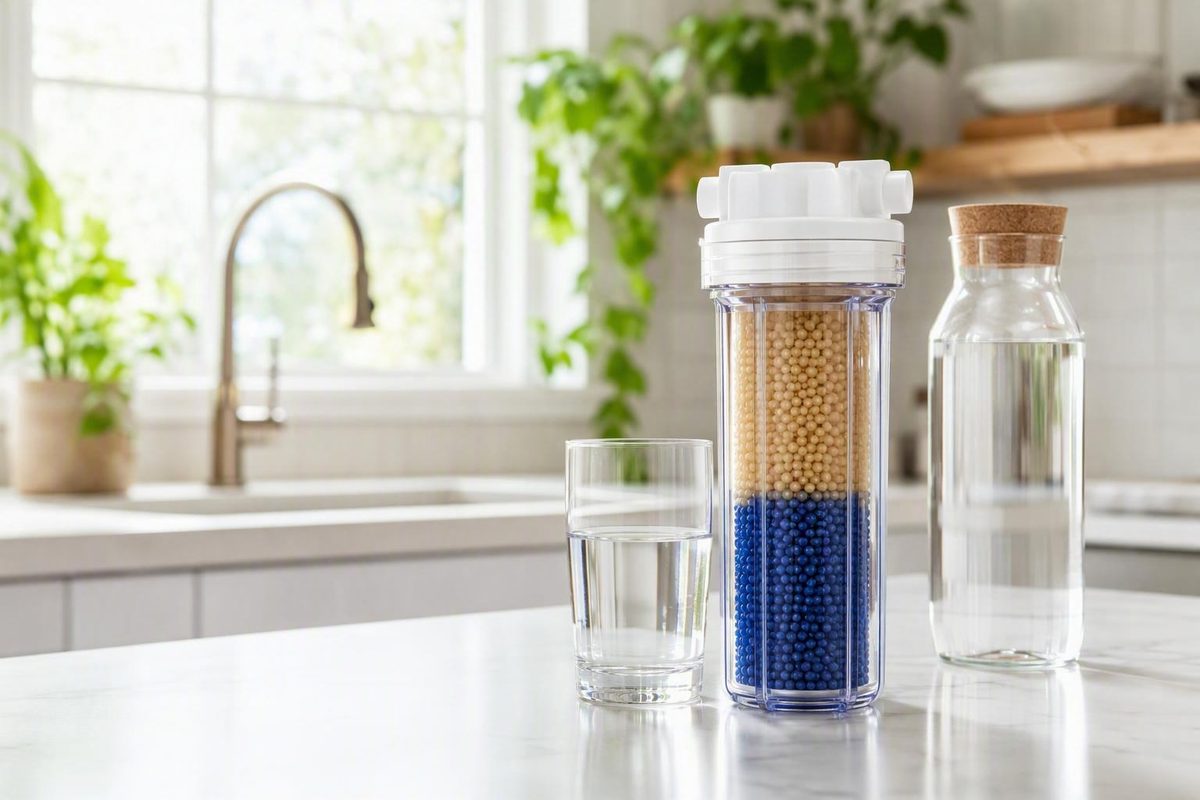
Deionization resin—usually shortened to DI resin—can produce water with very low ionic content when the media, pretreatment, flow, and monitoring method fit the application. A portable tank used for occasional spot-free rinsing has different requirements from an aquarium RO/DI unit, laboratory loop, boiler system, or manufacturing line.
Start by defining the required output. DI resin has no universal lifespan, and no single total dissolved solids threshold suits every use. Color change, elapsed time, spotting, and a display reading of 0 ppm can provide useful clues, but maintenance decisions should be based primarily on measured performance against an application-specific limit.
What DI resin is and how ion exchange works
DI resin is a water-treatment medium made from polymer beads with chemically active exchange sites. It removes dissolved charged species, or ions, by exchanging them for ions held by the resin. It is not a physical screen that strains particles from water.
A complete deionization process uses two functional resin types:
- Cation-exchange resin in the hydrogen, or H⁺, form exchanges hydrogen ions for positively charged ions. Representative targets include calcium, magnesium, sodium, and dissolved iron.
- Anion-exchange resin in the hydroxide, or OH⁻, form exchanges hydroxide ions for negatively charged species. Representative targets include chloride, nitrate, sulfate, bicarbonate, and exchangeable forms of silica.
As water contacts the media, dissolved ions occupy exchange sites. The hydrogen and hydroxide ions released by the two resin types combine to form water. This is the basic chemistry behind separate-bed and mixed-bed deionization, as outlined in Crystal Quest’s DI resin overview.
The terminology can be confusing because some sellers contrast “DI resin” with “mixed-bed resin.” More precisely:
- DI resin is the broad category of ion-exchange media used for deionization.
- Mixed-bed DI resin blends cation and anion beads in one vessel or cartridge.
- Dual-bed or separate-bed DI places cation and anion media in separate vessels, normally operated in sequence.
Mixed-bed resin creates alternating cation and anion exchange zones throughout one vessel. This arrangement is commonly used for final ionic polishing because water repeatedly encounters both resin types. Separate beds do not create the same intimate mixture, but they allow each resin type to be managed and regenerated independently.
Neither configuration should be described as removing every substance or producing absolute purity. Actual performance depends on feed-water composition, resin formulation and condition, contact time, flow distribution, temperature, vessel design, and the point at which the operator considers the output unacceptable.
What DI resin removes—and what it can leave behind
DI resin is effective against many dissolved mineral ions and salts. However, deionized describes a treatment mechanism, not a complete water-safety or process-quality specification. Ionic targets must be distinguished from materials that require another treatment method.
| Material category | Representative examples | Role of DI | Important limitation |
|---|---|---|---|
| Positively charged ions, or cations | Calcium, magnesium, sodium, iron | H⁺-form cation resin can exchange for these ions | Removal and breakthrough depend on concentration, competing ions, flow, and resin condition |
| Negatively charged ions, or anions | Chloride, nitrate, sulfate, bicarbonate, silica in exchangeable forms | OH⁻-form anion resin can exchange for these species | Breakthrough can vary by species and may not be predictable from TDS alone |
| Suspended material | Sand, rust particles, silt, debris | Not inherently removed through ion exchange | Use suitable particulate or sediment filtration |
| Disinfectants and oxidants | Chlorine and chloramines | DI should not be assumed to provide adequate control | Use the pretreatment specified for the disinfectant and system |
| Microorganisms | Bacteria and other microbes | Not inherently controlled by ordinary DI resin | Sanitation, disinfection, validated barriers, or microbiological testing may be required |
| Dissolved gases | Carbon dioxide and other gases | Not reliably controlled as a class by standard DI alone | Degassing or another application-specific process may be needed |
| Non-ionized organic compounds | Many solvents, oils, and neutral molecules | Often poorly represented by ionic measurements and not inherently removed | Carbon, membranes, oxidation, or another targeted treatment may be appropriate |
Calcium, magnesium, sodium, iron, chloride, nitrate, sulfate, bicarbonate, and silica may be addressed when present in exchangeable ionic forms. That does not mean every ion will be controlled equally or for the same portion of a service run. Feed chemistry, competing ions, pH-related speciation, flow, and the required endpoint can affect the breakthrough pattern.
DI is also not sediment filtration. Suspended particles might enter or become lodged in an unprotected vessel, but trapping them is not the intended exchange mechanism. Use the particulate pretreatment specified for the downstream equipment.
The same distinction applies to microorganisms and non-ionized organic compounds. Detroit Sponge’s comparison of separate-bed and mixed-bed resin notes that DI primarily addresses dissolved ions rather than bacteria or organic compounds. DI should likewise not be treated as a substitute for specified particle, disinfectant, gas, organic, or microbiological controls.
A low TDS result does not resolve these limitations. It does not identify individual ions or establish microbiological quality. Neutral organic compounds, suspended particles, microorganisms, and some dissolved gases may be poorly represented or not represented at all.
The relevant endpoint depends on the application:
- For spot-free rinsing, acceptable performance may mean water that dries without visible mineral residue under the working conditions.
- An aquarium operator may need to monitor particular ions relevant to livestock or algae control.
- A laboratory or manufacturing process may specify conductivity, resistivity, silica, particles, organics, microorganisms, or particular contaminants.
- Boiler and industrial users may have process-specific requirements for hardness, alkalinity, silica, conductivity, or gases.
Select equipment and tests from the applicable process specification, validated method, customer requirement, or equipment manual. A generic label such as “laboratory,” “medical,” “pharmaceutical,” or “semiconductor grade” does not by itself show that a cartridge meets a particular operation’s requirements.
DI, reverse osmosis, softening, carbon, and sediment filtration compared
Water-treatment stages are not interchangeable. Each is intended to address a different part of the incoming load.
| Treatment stage | Primary purpose | What it does not by itself establish |
|---|---|---|
| Sediment filtration | Captures suspended particles within the filter’s effective retention range | Removal of dissolved salts, gases, disinfectants, or microorganisms |
| Activated carbon treatment | Adsorbs or reacts with specified compounds; suitable products and contact conditions may address chlorine or chloramine | Broad removal of dissolved mineral ions |
| Water softening | Exchanges hardness ions such as calcium and magnesium, commonly for sodium or potassium | Major reduction in total dissolved ionic material |
| Reverse osmosis | Uses a membrane to reject much of the dissolved and particulate burden | Complete contaminant removal or final high-purity output without monitoring |
| Deionization | Exchanges positively and negatively charged dissolved species | Sediment filtration, disinfection, degassing, or broad removal of nonionic organics |
A softener and a deionizer both use ion exchange, but they have different objectives. Softening replaces hardness-forming ions with another ion. The water may form less scale while retaining a similar overall amount of dissolved ionic material. DI uses paired cation and anion media to remove both sides of dissolved salts.
Reverse osmosis, or RO, is a membrane-separation process. In an RO/DI system, RO removes much of the incoming burden before the water reaches the DI stage. DI then polishes the permeate by exchanging ions that pass through the membrane.
A conceptual treatment train may include:
- Particulate pretreatment to protect downstream components.
- Appropriate carbon treatment where chlorine, chloramines, or specified organic compounds must be controlled.
- Reverse osmosis for bulk reduction of dissolved material.
- DI resin for final ionic polishing.
- Additional controls where required for microorganisms, dissolved gases, particles, organics, storage, or distribution quality.
RO before DI can reduce the ionic load on the resin and may extend its service life, particularly with higher-TDS feed water or substantial production demand. No fixed extension factor is defensible because membrane performance, feed composition, pressure, temperature, operating schedule, and the DI endpoint all affect the result.
DI-only treatment can still be reasonable. Occasional spot-free vehicle or window rinsing may suit a portable mixed-bed tank when the source water has a relatively low ionic load, required volume is modest, and output is monitored. Higher feed-water TDS or sustained production may justify RO pretreatment, but the comparison should include water use, pressure, replacement filters, resin, labor, required flow, and acceptable product-water volume. WindowCleaner.com similarly frames DI-only versus multistage treatment around source-water TDS and usage rather than one universal configuration.
Mixed-bed versus dual-bed deionization
A mixed-bed deionizer contains blended cation and anion resin in one vessel. A dual-bed deionizer uses a cation vessel followed by a separate anion vessel. Both remove ions, but they differ in final ionic quality, throughput role, footprint, and servicing.
| Decision factor | Mixed-bed DI | Dual-bed DI |
|---|---|---|
| Final ionic quality | Commonly selected for very low ionic content and final polishing | Usually provides lower final resistivity than a comparable mixed-bed polishing stage, although design matters |
| Throughput role | Often used to polish a pretreated stream or supply lower-volume, high-purity demand | Often used for bulk demineralization and higher-volume operation |
| Footprint | Can use one compact resin vessel | Requires separate cation and anion vessels |
| Regeneration | More involved because the blended resins must first be separated | Each bed can be regenerated independently |
| Maintenance model | Cartridge replacement, tank exchange, or specialist regeneration is common | Independent on-site or off-site regeneration may be practical for equipped operations |
| Typical system position | Final stage after RO or primary DI, or a stand-alone unit for suitable demand | Primary demineralization before an optional polishing stage |
| Main tradeoff | Strong final ionic polishing with more complex resin handling | Easier resin management but generally less complete final polishing |
Mixed-bed DI is commonly used as a final polisher because its blended beads create repeated cation and anion exchange opportunities. Under suitable feed, flow, temperature, resin, equipment, and measurement conditions, output can approach the high-purity benchmark of 18.2 MΩ·cm at 25°C. That is a condition-dependent benchmark, not a guaranteed result from every cartridge. Aqua General’s mixed-bed and dual-bed comparison also qualifies this benchmark by temperature and explains the additional separation required before mixed-bed regeneration.
Separate beds can be preferable when an operation needs bulk demineralization, higher throughput, or independent control over the two media. Because the resin types are already physically separate, each can be serviced independently.
Some systems combine the approaches:
- RO reduces the incoming dissolved burden.
- Separate DI beds perform primary demineralization.
- A mixed-bed vessel provides final polishing.
Not every installation needs all three stages. This arrangement is most relevant where substantial throughput and very low final ionic content justify the additional equipment and maintenance.
Regeneration is a major distinction. Cation and anion resins require different regeneration processes. In a dual-bed system, they are already separated. In a mixed bed, the bead populations must be separated before being treated through their respective processes, then adequately rinsed and remixed. Small mixed-bed cartridges are therefore commonly replaced, while portable tanks may be handled through an exchange service.
Blend ratio is not a universal purchasing specification. Commercial products include examples such as 1:1 and 40:60 cation-to-anion blends, but these are product-specific formulations. Match replacement media to the equipment and intended use rather than assuming all mixed-bed formulas are equivalent.
How to choose resin and system format for the application
Begin with the process requirement, not a bag size or a “zero TDS” claim. A practical selection framework asks:
- What is in the feed water? Consider relevant water analysis rather than TDS alone. Hardness, alkalinity, silica, sodium, chloride, sulfate, iron, disinfectants, and application-specific organic or microbial concerns may affect the treatment train.
- What output is required? Define the maximum acceptable TDS or conductivity, minimum resistivity, and any contaminant-specific limits.
- How much water is needed? Record daily, weekly, peak, and batch volume.
- What flow is required? Performance observed at a low sampling flow may not be reproduced at production flow.
- How variable is the source? Municipal blending, seasonal changes, well conditions, and upstream RO performance may change the resin load.
- What space and utilities are available? Consider vessel size, pressure, drainage, RO concentrate, electrical needs, and service access.
- How will the media be maintained? Decide whether cartridges will be replaced, tanks exchanged, or resin regenerated by a properly equipped operation.
Questions by application
| Application | Questions to answer before buying |
|---|---|
| Vehicle, window, or solar-panel rinsing | What feed TDS and volume will the system see? What measured endpoint prevents unacceptable spotting? Is portability more important than resin economy? |
| Aquariums | Which source-water ions are relevant? How well is the RO stage performing? What post-DI endpoint is appropriate? Will the product water need remineralization or blending? |
| Laboratories | Which analytical or procedural specification applies? Are ions, organics, particles, microorganisms, and storage quality controlled separately? |
| Electronics | What conductivity or resistivity, silica, particle, organic, and microbial limits does the process require? Is a recirculating polished loop needed? |
| Boilers | What does the boiler or treatment program specify for hardness, alkalinity, silica, conductivity, and dissolved gases? |
| Manufacturing | Which product, rinse, cleaning, coating, or wastewater requirement controls the design? What flow, storage, and redundancy are required? |
These examples do not establish that a generic DI cartridge satisfies an industry standard. The resin is only one component of the water system.
Purchase formats
DI resin is sold as:
- Loose media for compatible refillable cartridges or vessels
- Sealed refill bags
- Pre-filled disposable cartridges
- Refill kits with accessories such as a funnel, cap, lubricant, or instructions
- Portable exchange tanks
- Bulk quantities, often described in fractions or multiples of a cubic foot
Verify actual usable media volume rather than relying on phrases such as “standard refill.” Listings may describe empty cartridges, filled cartridges, refill bags, kits, and loose bulk media, so package names are not directly comparable.
Before ordering, confirm:
- Vessel or cartridge dimensions
- Usable resin volume
- Intended flow direction
- Required cap, foam ring, sponge, screen, or distributor
- Equipment-specified flow and pressure limits
- Whether the resin is supplied wet and ready for use
- Compatibility with the exact housing or tank model
- Storage instructions for unopened and partially used media
Media-only pricing cannot be compared directly with a kit containing a funnel, distributor cap, lubricant, or other components. Compare usable resin volume, credible cartridge-fill count, package protection, compatibility, and accessory needs. A universal cost-per-gallon figure cannot be calculated reliably without resin-capacity data, feed chemistry, system performance, flow, and a defined endpoint.
Indicating versus non-indicating resin
Indicating resin contains a dye system that changes appearance as the relevant chemical condition moves through the bed. In a transparent cartridge, it provides a convenient visual cue.
Non-indicating resin does not provide that cue, so instrumental monitoring is necessary from the outset. This is not necessarily a disadvantage because output measurement should be the primary performance check for either type. Kolar Labs offers both formulations and recommends post-treatment TDS monitoring rather than relying on color alone.
For aquarium use, very low-ion RODI water is a starting ingredient rather than automatically finished livestock water. Depending on the aquarium and method, it may need an appropriate salt mix, remineralization, or controlled blending before use. Follow the requirements of the species and system.
How to monitor DI output and recognize exhaustion
Resin is exhausted for practical purposes when it can no longer maintain the output required by the application. The primary replacement signal is therefore a sustained deterioration in measured post-DI quality, confirmed under normal operating conditions.
Three related measurements are commonly used:
- TDS is an estimated concentration calculated by the instrument from measured conductivity using its selected conversion factor. It is convenient for trend monitoring but does not identify contaminants.
- Conductivity measures how readily water conducts electrical current. Dissolved mobile ions generally increase it.
- Resistivity describes the inverse electrical behavior and is commonly used for very low-ionic-content water.
Choose an instrument and parameter appropriate to the process. A spot-free rinse operator may monitor post-DI TDS trends, while a high-purity operation may specify conductivity or resistivity. Acceptance limits should come from the application, not a generic package label.
A displayed 0 ppm TDS does not mean the water contains no contaminants. It does not establish the absence of residual ions, particles, microorganisms, dissolved gases, or non-ionized organic compounds.
Resistivity depends on temperature; the widely cited 18.2 MΩ·cm high-purity benchmark is associated with 25°C and suitable measurement conditions, not with an ordinary meter merely displaying zero.
A practical monitoring routine
- Record the source-water reading under reasonably consistent conditions.
- If RO is installed, record the RO-permeate reading before DI.
- Record the post-DI reading at the same operating stage and flow.
- Note the date, approximate volume produced, and maintenance performed.
- Repeat unexpected results using the instrument’s specified sampling procedure.
- Replace or service the resin when confirmed output exceeds the application’s limit.
Tracking feed, post-RO, and post-DI readings makes troubleshooting easier. If post-DI quality deteriorates while RO permeate remains stable, the DI stage is the likely focus. If both RO permeate and post-DI readings rise, something upstream may have increased the load reaching the resin.
Color change, renewed spotting, and calendar age are secondary indicators:
- A moving color front should prompt a meter check.
- Renewed spotting should prompt measurement and a review of rinsing and drying conditions.
- Calendar age may prompt inspection where storage, intermittent operation, or a model-specific maintenance schedule matters.
Seller recommendations vary. Some advise replacement after any TDS rise; others cite a particular ppm level, visible spotting, color change, or an annual schedule. None is universal because applications have different endpoints, meters have different resolution, and feed-water loads vary. Use repeat measurements and compare the confirmed result with the defined limit for the actual use.
Resin life and troubleshooting premature exhaustion
There is no defensible fixed lifespan based only on cartridge size and feed TDS. Two waters with the same displayed TDS can contain different proportions of ions, and those ions do not necessarily consume or break through the resin in the same way.
Service life varies with:
- Complete feed-water chemistry
- Ionic concentration and competing-ion profile
- Total water volume treated
- Required output endpoint
- Flow and contact conditions
- RO performance and other pretreatment
- Resin age, storage, and condition
- Packing and hydraulic distribution
- Vessel and distributor design
- Operating conditions
- Maintenance practices
A numerical resin-life calculator based only on TDS, daily gallons, and cartridge size would omit resin capacity, ionic composition, leakage and breakthrough behavior, and the application-specific endpoint.
Troubleshooting sequence
When resin appears to exhaust unusually quickly, work through the system in order.
1. Confirm the meter and sampling method
Follow the instrument instructions for rinsing, sampling, stabilization, and maintenance. Make sure an inline probe is installed at the intended measurement point and that stagnant water is not being confused with normal production output.
2. Compare feed, post-RO, and post-DI readings
A single post-DI number cannot show where performance changed. If the source water or RO permeate has deteriorated, shorter DI service life may be expected even when the cartridge itself is functioning normally.
3. Check upstream treatment
Service sediment and carbon stages according to their own criteria. For an RO system, review pressure, flow, concentrate production, membrane condition, and permeate quality according to the equipment manual. Reduced RO performance can increase the ionic load reaching DI.
4. Verify flow direction and cartridge placement
Confirm that each cartridge is in its designated housing and oriented as the manufacturer specifies. Do not assume that one installation direction applies to every cartridge or vessel.
5. Inspect packing, distributors, seals, and possible bypass paths
Incremental filling and repeated tapping are common vendor instructions, but the evidence does not establish one universal packing density. Inspect the cartridge components and housing seals according to the model’s instructions.
6. Review production flow and demand
Confirm that production flow remains within the equipment specification. A sharp increase in daily volume can make normal exhaustion appear premature.
7. Confirm breakthrough before replacing resin
Repeat the post-DI measurement under normal operating conditions. If output remains outside the application limit after upstream and hydraulic issues have been checked, replace, exchange, or professionally service the resin.
An early color change is not conclusive evidence of exhaustion. Measure the output and inspect the system. Color behavior may not align exactly with the required endpoint.
Leftover resin after filling is also not proof of incorrect installation. Package quantity, settling, reusable-cartridge capacity, and retaining components vary. Follow the specified fill procedure rather than forcing every bead into the housing.
Do not diagnose a partly air-filled housing as either harmless or defective from appearance alone. The significance depends on the model’s flow path, outlet position, pressure, and housing design. Consult the equipment’s hydraulic guidance, and never loosen a pressurized housing to investigate.
Replacing and packing a refillable DI cartridge safely
Replacement details vary by equipment. Consult the system manual and resin instructions before opening a housing, particularly for pressurized tanks, large vessels, sanitary systems, or critical processes.
Shut off the source water, isolate the relevant section, and relieve trapped pressure by the manufacturer’s procedure before removing a canister. Bulk Reef Supply’s RO/DI filter-change instructions likewise begin with shutting off the water and relieving pressure before the housing is opened.
Prepare a bucket, absorbent towels, clean tools, any needed replacement seals, and the correct housing wrench. Contain spilled beads and clean them up promptly because loose DI resin can create a serious slipping hazard, as noted in AirWaterIce’s DI resin replacement procedure.
Replacing a pre-packed cartridge
A pre-packed cartridge is normally replaced as a complete unit.
- Shut off and isolate the system.
- Relieve trapped pressure according to the equipment manual.
- Place a bucket or towel beneath the housing.
- Open the housing without damaging it or the connected tubing.
- Remove the old cartridge and note its orientation.
- Clean the housing as specified and inspect the O-ring, groove, and mating surfaces.
- Install the replacement in the specified housing and flow direction.
- Reassemble without cross-threading or displacing the O-ring.
- Restore pressure gradually.
- Inspect the housing, cap, tubing, and fittings for leaks.
- Flush according to the equipment or cartridge instructions.
- Confirm post-DI quality before collecting product water.
Vendor instructions for some common axial-flow RO/DI cartridges say the directional arrow should point upward. That is not a universal vessel rule; follow the arrow and manual supplied with the actual cartridge.
Refilling a reusable cartridge
A refillable cartridge requires additional care because media distribution affects water contact.
- Depressurize and remove the cartridge. Follow the same isolation procedure used for a pre-packed cartridge.
- Open it over a suitable container. Retain the reusable cap, foam rings, sponges, screens, and distributor parts required by the design.
- Remove the exhausted media. Keep beads out of drains and off walking surfaces.
- Clean and inspect the cartridge. Check the body, cap, threads, screens, retaining pads, and seals according to the equipment instructions.
- Add fresh resin incrementally. Do not fill the entire cartridge in one uncontrolled pour.
- Tap and settle the beads. Hold the cartridge upright and tap it repeatedly to reduce voids and create an even bed.
- Continue filling and settling. Use the supplier’s specified fill level and packing method rather than assuming every cartridge requires the same compression.
- Reinstall internal components. Fit the foam ring, sponge, screen, cap, or distributor in the specified order.
- Clear sealing surfaces. Remove beads from threads, O-rings, grooves, and mating faces.
- Install the cartridge in the correct housing and orientation.
- Restore pressure gradually and inspect for leaks.
- Flush and verify output before use.
Some vendor procedures specify a 60-second flush and discarding the first one or two gallons, but those figures apply only to the systems covered by those instructions. Resin type, cartridge volume, equipment design, sanitary requirements, and intended use may require a different procedure. Follow the manual for the installed equipment.
After flushing, measure the post-DI output. A full housing and absence of visible leaks do not by themselves establish acceptable water quality.
Replacement, exchange, regeneration, and disposal
An exhausted bed can be handled in three main ways:
- Replace the media or cartridge.
- Swap or send the tank through a professional exchange service.
- Regenerate the resin in a properly equipped operation.
Mixed-bed regeneration is not an appropriate casual do-it-yourself chemical project. The cation and anion components must first be separated, treated through their different regeneration processes, rinsed, verified, and remixed. Chemical handling, worker protection, wastewater management, and product-quality checks require suitable facilities and procedures.
Disposal should account for the resin’s service history. Consult the resin safety data sheet, exchange-service instructions, process documentation, and local waste authority. Do not assume that resin used to capture process chemicals or regulated contaminants can be handled in the same way as resin used only on an ordinary potable feed.
Frequently asked questions
Does 0 ppm TDS mean DI water is completely pure?
No. It means the meter did not display a value above its resolution under the measurement conditions. It does not prove the absence of residual ions, particles, microorganisms, gases, or non-ionized organic compounds.
Use the measurements required by the application. High-purity processes may need suitable conductivity or resistivity instrumentation plus contaminant-specific, organic, particle, or microbiological testing.
How long does DI resin last?
There is no universal lifespan. Service life depends on feed chemistry, the ionic load reaching the bed, water volume, flow, pretreatment, packing, resin condition, system design, and the required endpoint.
Track feed or RO-permeate quality alongside post-DI quality. Replace or service the resin when confirmed output exceeds the application limit—not automatically after a fixed number of gallons or months.
Is color-changing DI resin more reliable than non-indicating resin?
Not inherently. Indicating resin provides a visual cue; non-indicating resin requires instrumental monitoring from the beginning. Neither eliminates the need to measure output.
Treat a color front or unexpected color change as a prompt to test the water. A sustained deterioration against the defined TDS, conductivity, or resistivity limit is the stronger maintenance signal.
Should reverse osmosis come before DI resin?
Often, but not always. RO can reduce the dissolved load reaching DI and may extend resin service life, particularly with higher-TDS feed water or sustained production.
DI-only treatment may still suit low-volume use with relatively low ionic feed water, compact-equipment needs, and careful monitoring. Compare the complete system for the actual source water and production demand.
Can exhausted mixed-bed DI resin be regenerated?
Yes, but regeneration is more complicated than servicing separate beds. The cation and anion beads must be separated before receiving their different treatments, then rinsed, checked, and remixed correctly.
For small cartridges and portable systems, replacement or professional tank exchange is often more practical. On-site regeneration should be limited to operations equipped for chemical handling, quality control, worker protection, and waste management.
A measurement-led decision sequence
First identify what must be removed. Then define the required output quality, production volume, and flow. Use those requirements to decide whether DI-only treatment is sufficient or whether sediment, carbon, RO, or other pretreatment is needed. Choose mixed or separate beds according to purity, throughput, footprint, and maintenance capability.
Once the system is operating, monitor the actual product water. Resin color, elapsed time, renewed spotting, and a nominal 0 ppm display are clues rather than universal proof of acceptable performance or exhaustion.
Safe servicing means following the model-specific procedure: isolate and depressurize the equipment, pack and orient cartridges correctly, restore pressure gradually, check for leaks, flush as directed, verify output, and dispose of spent media with its captured contaminants in mind.